Australia Repositioning Cruises: To and From Sydney, Brisbane and Perth
By the Repositioning Cruises editors 7 min read Updated October 2026
Crossing
From
Asia, Pacific
To
Australia
Updated: Expanded in October 2026, with sailing counts from our finder data and facts re-checked on the cruise lines' own websites.
Worth knowing
- Our finder lists 65 one-way sailings to or from Australia between October 2026 and December 2027
- Almost half link Australia with Asia, mainly Singapore and Bali, not North America
- Pacific crossings to or from Honolulu, Los Angeles and Seattle run 15 to 50 nights
- Sydney is the Australian port on 54 of the 65 sailings, Brisbane on 7
- Regent, Princess and Carnival have the most, ahead of Royal Caribbean, Viking and Celebrity
- US citizens need an Australian ETA; any New Zealand call needs an NZeTA
Ports of call
- Australia repositioning in numbersI
- Arriving for the season: September to DecemberII
- Leaving Australia: February to AprilIII
- Asia route or Pacific route?IV
- Sydney's cruise terminalsV
- Documents and moneyVI
- Which lines to look atVII
- What these voyages costVIII
- Practical points for a long southern voyageIX
Australia repositioning cruises exist because Australia’s cruise season runs opposite to the northern one. Ships arrive for the southern summer between September and early December, mostly into Sydney, and leave again between late February and April for Alaska, Asia and Europe. They come and go by two very different routes: north to Singapore, Bali or Hong Kong, or east across the Pacific to Honolulu, Los Angeles and Seattle.
Most North American guides only describe the second. In the sailings our finder tracks, the Asian route is actually the busier one, and it is shorter, with more ports. Which suits you depends mostly on how many sea days you want and where you need to fly home from.
Australia repositioning in numbers
Of the 517 repositioning sailings in our repositioning cruise finder, each checked on the cruise line’s own website in late September 2026, 65 start or end in Australia between October 2026 and December 2027. Regent Seven Seas has 11, Princess 10, Carnival 9, and Royal Caribbean, Viking and Celebrity 7 each, followed by Oceania, Holland America, Norwegian and Cunard.
| Corridor | Sailings | Nights | Main lines | Typical timing |
|---|---|---|---|---|
| Australia and Asia (Singapore, Bali, Hong Kong, Bangkok, Tokyo) | 31 | 7 to 32 | Regent, Viking, Princess, Carnival, Oceania, Celebrity | Arrive October to December, leave February and March |
| Australia and North America or Hawaii | 21 | 15 to 50 | Royal Caribbean, Princess, Celebrity, Holland America | Arrive late September to November (a few in January and February), leave March and April |
| Australia and the South Pacific or New Zealand | 10 | 4 to 21 | Norwegian, Regent, Oceania, Carnival | Spread through the year |
| Within Australia (Brisbane or Melbourne to Sydney) | 3 | 2 | Carnival, Royal Caribbean | April and December |
Sydney is the Australian end on 54 of the 65. Brisbane appears on 7, Perth (Fremantle) on 4, and Darwin, Cairns and Melbourne on one each.
Arriving for the season: September to December
From Asia. These arrivals are typically 13 to 16 nights from Singapore or Bali, working down the Queensland coast through Darwin, Cairns, Airlie Beach or Townsville before finishing in Sydney or Brisbane. Examples in our data: Princess’s Royal Princess from Singapore to Sydney in November 2026 (15 nights via Bali, Darwin, Cairns and Brisbane), Oceania Riviera and Regent’s Seven Seas Explorer from Bali, and Viking Orion and Viking Venus from Bangkok in late 2027 (28 nights). Carnival Luminosa comes from Hong Kong to Brisbane in October 2027 (16 nights).
Across the Pacific. The northern hemisphere ships come in from Hawaii and the US West Coast. Royal Caribbean’s Anthem of the Seas and Celebrity Edge and Solstice sail Honolulu to Sydney in 17 to 18 nights by way of Tahiti, Samoa, Fiji or New Zealand, and Ovation of the Seas does Honolulu to Brisbane in 16. From the mainland, Holland America’s Westerdam leaves Seattle for Sydney in September 2027 (34 nights), Royal Caribbean’s Voyager of the Seas sails Seattle to Brisbane (25 nights), and Princess runs Los Angeles to Sydney in 27 to 50 nights; our guide to repositioning cruises from Los Angeles covers that end. Our Hawaii repositioning guide covers the Honolulu to Sydney leg port by port.
Leaving Australia: February to April
This is when the repositioning cruises from Sydney happen. Our finder lists 23 one-way departures from Sydney in total, and 16 of them leave between late January and late April 2027.
- To Asia, late January to mid-March: Carnival Adventure, Holland America’s Volendam, Princess’s Coral Princess and Regent’s Seven Seas Splendor to Singapore; Oceania Vista, Oceania Riviera, Viking Orion and Viking Venus to Bali; Cunard’s Queen Victoria to Hong Kong. Lengths run 13 to 19 nights, except Coral Princess, which takes 32 nights via New Zealand and Fremantle.
- To North America, late March and April: Holland America’s Noordam to Seattle (29 nights), Princess’s Royal Princess to Los Angeles (26), Carnival Luminosa to San Francisco (23), and Celebrity Solstice, Royal Caribbean’s Anthem of the Seas and Celebrity Edge to Honolulu (15 to 17).
- From Brisbane: Royal Caribbean’s Quantum of the Seas sails to Seattle in April 2027 (23 nights via Tahiti and Honolulu).
The Pacific departures are timed so the ships reach Alaska for May. If you want a ship that ends in North America, March and April are the only realistic window. For the crossing itself, including the date line and sea days, see our guide to transpacific repositioning cruises.
Asia route or Pacific route?
| Sydney and Asia | Sydney and North America | |
|---|---|---|
| Typical length | 13 to 19 nights | 15 to 18 nights to or from Honolulu, 18 to 36 to or from the mainland |
| Ports | Frequent: Queensland coast, Darwin, Komodo or Lombok, Bali | Fewer: Pacific islands, then long ocean stretches |
| Climate | Tropical most of the way | Warm tropics, then cooler on arrival in Seattle or San Francisco in April |
| Flight at the far end | Singapore or Bali to home | Domestic for Americans if the ship ends on the mainland |
| Date line | Not crossed | Crossed once |
For an American, the Pacific route has one big advantage: the voyage ends at home, so only one long-haul flight is needed, the one out to Sydney. For an Australian, the same logic favors the Asian route, which ends a shorter flight from home.
Sydney’s cruise terminals
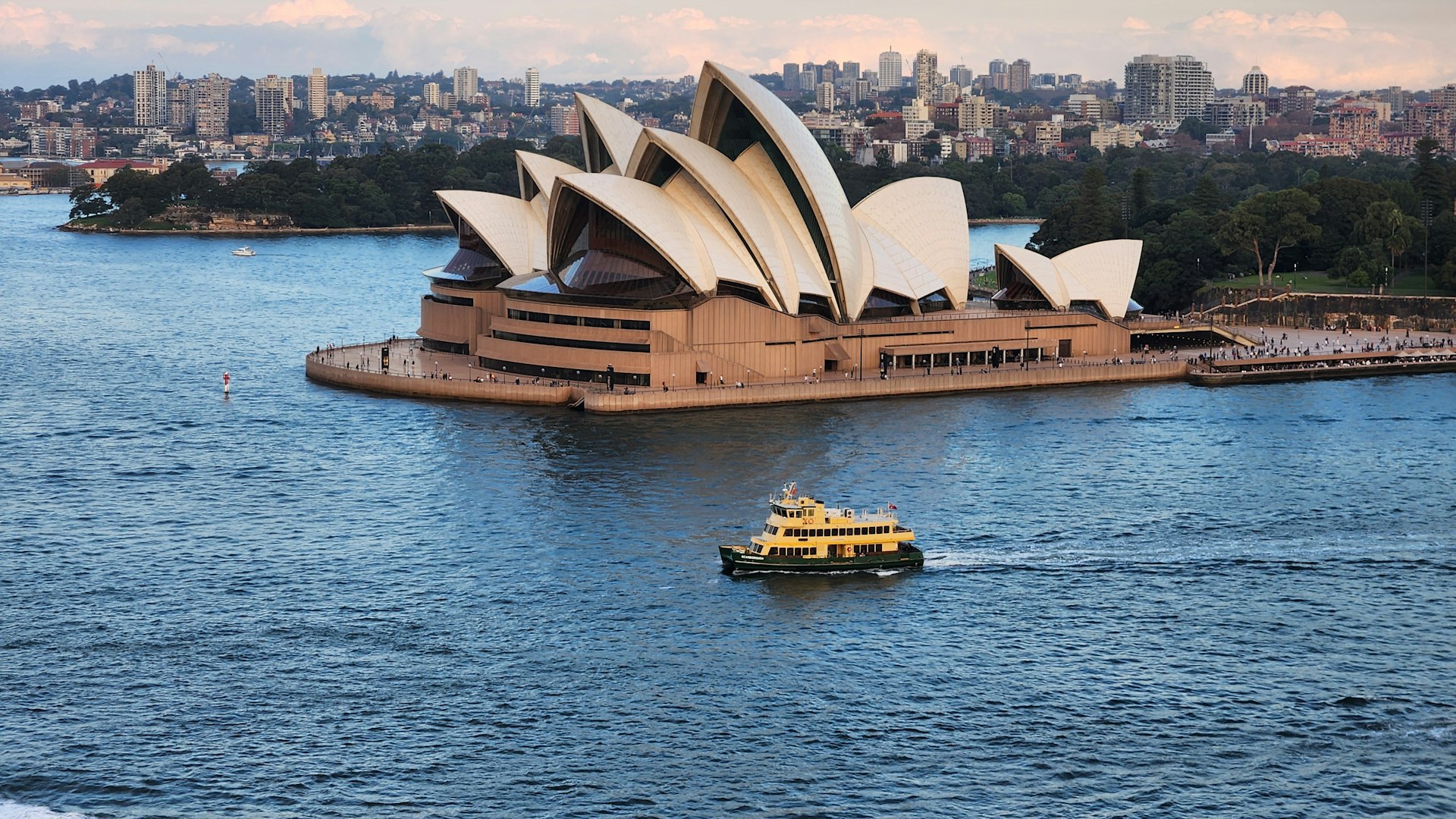
Sydney Harbour has two dedicated cruise terminals, according to the Port Authority of New South Wales: the Overseas Passenger Terminal at Circular Quay, opposite the Opera House, and White Bay Cruise Terminal at Balmain, just west of the Harbour Bridge. Because White Bay sits beyond the bridge, ships too tall to pass under it use Circular Quay. Your booking names the terminal, and they are far enough apart that it matters for hotels and transfers.
Sailing into Sydney Harbour past the Opera House is a highlight for many passengers, which is a small argument for the inbound direction if you have the choice.
Documents and money
- Australia: US citizens need an Electronic Travel Authority before arrival. The Department of Home Affairs lists an AUD 20 service charge for the ETA app, stays of up to three months per visit, and cruising as a permitted activity. Apply from outside Australia and wait for the grant before booking flights.
- New Zealand: if your itinerary calls at Auckland, Tauranga, Wellington or the Bay of Islands, Immigration New Zealand requires an NZeTA from every cruise passenger, regardless of nationality, applied for before the ship sails for New Zealand.
- Asia and the islands: Singapore, Indonesia, Fiji, Tahiti and the others each have their own entry rules. The cruise line’s pre-departure documents are the best summary for your specific itinerary.
- Australians sailing to the US: you will enter the United States at Honolulu or the mainland port, so check the US entry requirements for your passport well ahead.
Which lines to look at
The lines split cleanly by route in our data. Royal Caribbean and Celebrity run all of the Honolulu crossings, using the same ships that spend the northern summer in Alaska or Hawaii. Princess runs the longest voyages, between Sydney and Los Angeles, including the only 50-night option. Holland America sends ships between Sydney and Seattle and between Sydney and Singapore.
The Asian route belongs to the smaller and luxury ships. Regent, Viking and Oceania together account for 23 of the 65 Australian sailings, most of them between Australia and Bali, Singapore or Bangkok, often with Komodo or Lombok on the way, and the rest within the South Pacific. Carnival is the exception at the mainstream end: it moves its Australian fleet to and from Singapore and runs a 23-night Sydney to San Francisco crossing on Carnival Luminosa. For the luxury option, see our Regent repositioning guide.
What these voyages cost
Per night, long Pacific repositioning voyages tend to be among the cheaper ways to cruise, because three or four weeks at sea is a hard sell. In total they are not cheap: a month aboard adds up even at a low nightly rate, and the long-haul one-way flight at one end often costs as much as a week of the cruise. Fares change daily, which is why our finder links to each line’s own page rather than listing prices.
Two things keep the total down. Book the flight when you book the cruise, since one-way long-haul fares rise sharply close to departure. And if you are going to Australia anyway, sailing in on a repositioning voyage replaces one of the two flights you would have bought. Our guide to flights home after a repositioning cruise covers how late you can safely fly on arrival day.
Practical points for a long southern voyage
- Two climates. A March or April crossing from Sydney to Seattle starts in late summer and ends in a Pacific Northwest spring. Pack layers; our packing list for long crossings works for the Pacific too.
- Clocks. Sailing from Australia toward North America, the clocks go forward an hour on many nights, and you repeat a calendar day at the date line. Our explainer on cruise time changes covers how ships handle it.
- Cyclone season. The South Pacific cyclone season overlaps the start of the Australian summer. Ships route around storms, which can change or drop island calls.
If you want the most ports for the fewest days, sail Sydney to Singapore or Bali in February or March. If you want the classic long crossing and a flight home that is only domestic, take one of the April sailings from Sydney or Brisbane to the West Coast.
From the finder
Upcoming sailings
64 one-way sailings that match this guide, checked on the cruise lines' own websites on September 29, 2026. Fares change daily, so follow the link to see today's price.
Sydney → Los Angeles
Crown Princess
Princess Cruises
Bali (Benoa) → Sydney
Viking Venus
Viking
Singapore → Sydney
Royal Princess
Princess Cruises
Bali (Benoa) → Sydney
Oceania Riviera
Oceania Cruises
Sydney → Singapore
Celebrity Solstice
Celebrity Cruises
Singapore → Brisbane
Carnival Luminosa
Carnival Cruise Line
Lautoka → Sydney
Norwegian Spirit
Norwegian Cruise Line
Bali (Benoa) → Sydney
Seven Seas Explorer
Regent Seven Seas Cruises
No sailings match these filters. Try a wider month or any cruise line.
Questions before booking
What repositioning cruises leave from Sydney?
Our finder lists 23 one-way departures from Sydney between October 2026 and December 2027. Thirteen go to Asia (Singapore, Bali and Hong Kong, 13 to 32 nights), eight cross the Pacific to Honolulu, Los Angeles, San Francisco or Seattle (15 to 30 nights), and two go to Fiji or Auckland. Most leave between late February and late April.
Are there repositioning cruises from Brisbane?
A few. The main one in our data is Royal Caribbean's Quantum of the Seas, Brisbane to Seattle in 23 nights via Tahiti and Honolulu in April 2027. Carnival and Royal Caribbean also run 2-night Brisbane to Sydney moves, and several ships arrive in Brisbane from Hong Kong, Singapore and Honolulu at the start of the season.
When do cruise ships reposition to Australia?
Mostly between September and early December, ahead of the southern summer. In our data, Pacific arrivals from Honolulu, Seattle and Los Angeles cluster in late September to mid-November, and Asian arrivals from Singapore, Bali and Bangkok in October to December. Departures run from late February to late April, timed for the Alaska and Asian seasons.
How long is a transpacific cruise to Australia?
From Honolulu, 16 to 18 nights. From Los Angeles or Seattle, usually 18 to 36 nights, and Princess has one 50-night voyage from Los Angeles via Japan. The longer the routing, the more South Pacific islands it includes, such as Tahiti, Fiji, Samoa, Tonga or New Caledonia, but every version has long runs of sea days.
Do I need a visa for a cruise to Australia?
US citizens need an Electronic Travel Authority, applied for through the Australian government's ETA app, which carries an AUD 20 service charge. If the itinerary calls in New Zealand, every cruise passenger needs an NZeTA before the ship sails for New Zealand, whatever their nationality. Asian ports have their own rules, so check each one.
Further voyages
Routes & Ports
Repositioning Cruises from Florida to Europe: Ports, Lines and Routes
Repositioning cruises from Florida to Europe leave mainly from Miami and Fort Lauderdale, with a few from Port Canaveral and Jacksonville, between March and May, and above all in April. They take 12 to 17 nights, usually via Bermuda, the Azores or Madeira, and end in Barcelona, Southampton, Rome (Civitavecchia), Lisbon or the Netherlands.
Routes & Ports
Alaska Repositioning Cruises: When Ships Arrive, When They Leave and Where They Go
Alaska repositioning cruises happen twice a year. Between late March and mid-May 2027, ships sail into Vancouver and Seattle from California, Hawaii, Japan, Australia and the Panama Canal for the Alaska season, and between early September and early November they leave. Most are 4 to 7 night coastal runs to Los Angeles or San Diego; the rest are 8 to 11 night Honolulu one-ways and 13 to 22 night Japan crossings, many with Alaska ports.
Routes & Ports
Repositioning Cruises from New York and Boston: Europe, Florida and Queen Mary 2
Repositioning cruises from New York and Boston run at the edges of the New England and Canada season. In spring and early fall, ships sail from New York or Boston to Southampton, Barcelona or other European ports in 7 to 16 nights, often via Halifax, Iceland or the Azores. In late fall, ships move south to Florida. Cunard's Queen Mary 2 is different: it crosses New York to Southampton on a schedule in seven nights.