Panama Canal Repositioning Cruises: Routes, Season and What to Expect
By the Repositioning Cruises editors 9 min read Updated September 2026
Crossing
From
Florida
To
West Coast
Worth knowing
- Westbound sailings run in spring, eastbound sailings in fall.
- Fort Lauderdale to Los Angeles is typically 14 to 16 nights.
- A full transit through all three lock sets takes 8 to 10 hours.
- Partial transits enter Gatun Lake and turn around on a round trip.
- Mid-December to mid-April is the dry season in Panama.
- Neither side of the ship is always better; forward open decks win.
- One-way sailings need a passport and a one-way flight home.
Ports of call
- When Panama Canal repositioning cruises sailI
- Full transit vs partial transitII
- How the transit works and how long it takesIII
- Old locks vs new locksIV
- Which side of the ship is bestV
- Which cruise lines sail Panama Canal repositioning routesVI
- What a Panama Canal repositioning cruise costsVII
- Planning points specific to this routeVIII
A Panama Canal repositioning cruise is a one-way sailing between Florida and the US West Coast that exists because a cruise line needs a ship on the other ocean. Ships head west in spring, from March to May, to start the Alaska season from Seattle, Vancouver or California. They head east in fall, from September to November, to spend the winter in the Caribbean. The canal crossing is the centerpiece, and it is the same 8 to 10 hour transit sold on dedicated Panama Canal cruises, usually at a lower nightly rate.
Length depends on where the ship starts and ends. Fort Lauderdale or Miami to Los Angeles or San Diego is typically 14 to 16 nights. Add San Francisco, Seattle or Vancouver and it grows to 18 to 22 nights. A handful of voyages start in New York and run to the Pacific Northwest, which can take closer to a month.
When Panama Canal repositioning cruises sail
The timing follows the Alaska calendar. Alaska cruises run from roughly May to September, so ships that spend the winter in the Caribbean need to be on the Pacific side by late April or May, and back in Florida by November. That produces two windows:
- Spring, westbound (March to May): Florida to San Diego, Los Angeles, San Francisco, Seattle or Vancouver. These fall inside Panama’s dry season, which the canal’s cruise lines generally put at mid-December to mid-April, so March and April sailings get the best weather at the locks.
- Fall, eastbound (September to November): the West Coast or Vancouver back to Florida. These are in the rainy season. The transit is not affected, but afternoon storms are common and it is hot and humid.
Outside those windows you will still find Panama Canal cruises, but they are dedicated itineraries rather than repositioning moves: round-trip partial transits from Florida in winter, or full transits by lines such as Holland America and Princess that sell the canal as a destination through the dry season. If you see a coast-to-coast sailing in December or January, it is usually one of those, and priced accordingly.
Full transit vs partial transit
A repositioning cruise is almost always a full transit, because the ship has to reach the other ocean. A partial transit is a round-trip product from Florida. The difference matters when you compare prices, because the two are often listed side by side.
| Full transit | Partial transit | |
|---|---|---|
| Route | Atlantic to Pacific or the reverse | Caribbean side into Gatun Lake and back out |
| Locks | Gatun, Pedro Miguel and Miraflores (or the new locks) | Gatun (or Agua Clara) only |
| Time in the canal | 8 to 10 hours | Most of one day, including time at anchor in the lake |
| Typical length | 14 to 22 nights, one way | 10 to 11 nights, round trip |
| Flights | One-way flight home | Round trip to one port |
| Main sights | Culebra Cut, Centennial Bridge, Bridge of the Americas, Panama City skyline | Gatun Locks and Gatun Lake; optional excursions ashore |
On a partial transit, the ship usually lifts into Gatun Lake in the morning, anchors while some passengers go ashore for excursions, and descends back to the Caribbean in the afternoon. It is a good introduction to how a lock works. It is not the same experience as crossing the continent, and people who do a partial transit first often come back for the full one.
How the transit works and how long it takes
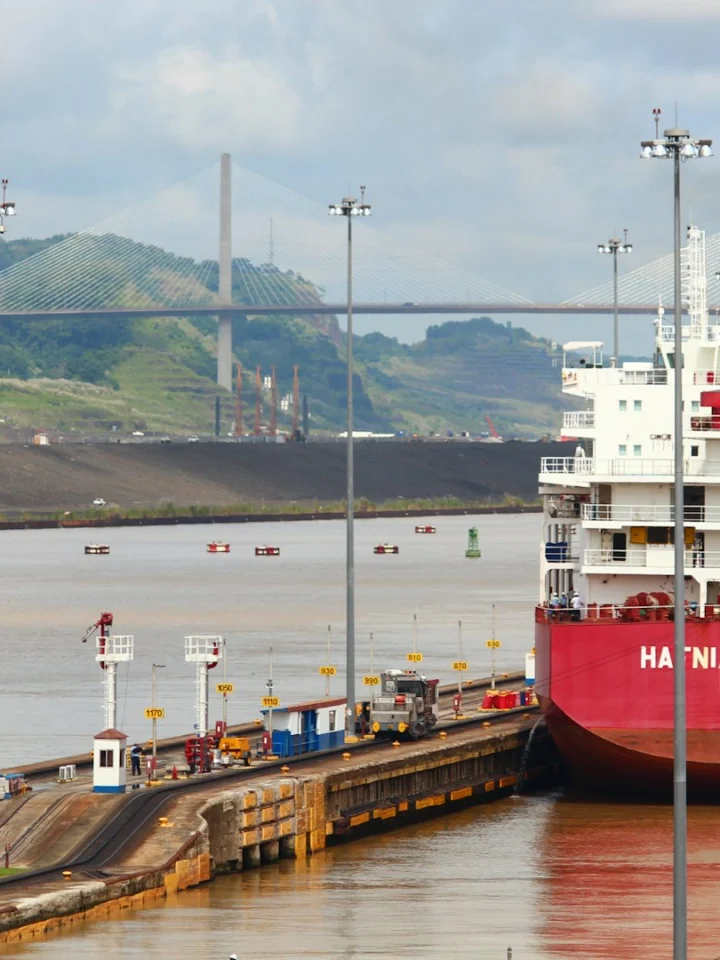
The canal is about 50 miles (80 km) long. Ships are lifted 85 feet to Gatun Lake, an artificial lake that forms most of the route, then lowered again on the other side. On the original canal that happens in three lock sets: Gatun on the Atlantic side with three steps, and Pedro Miguel (one step) and Miraflores (two steps) on the Pacific side, according to the Panama Canal Authority’s own description of the lock design.
Cruise lines quote 8 to 10 hours for the full crossing. The ship typically arrives at the entrance before dawn and waits its turn, so the first lock often starts around sunrise. Between the lock sets comes the part many passengers remember most: the crossing of Gatun Lake and the narrow Culebra Cut (also called the Gaillard Cut), where the canal was blasted through the continental divide and the Centennial Bridge passes overhead.
One geographic detail surprises people. The canal runs roughly northwest to southeast, not west to east, so the Pacific entrance near Panama City lies east of the Atlantic entrance near Colón. A westbound repositioning cruise is actually heading southeast while it crosses.
Old locks vs new locks
Since June 26, 2016, the canal has had a second set of locks for larger ships. The Neopanamax locks at Agua Clara (Atlantic) and Cocolí (Pacific) have chambers 1,400 feet long and 180 feet wide, against 1,000 by 110 feet in the original locks. The Panama Canal Authority marked the opening with the inaugural transit of the expanded canal.
For cruise passengers the difference is practical:
- Original locks: electric locomotives on rails, nicknamed mules, run alongside the ship on cables and keep it centered. The walls are close enough to touch from a low deck, and the locks themselves date from the canal’s opening in 1914. This is the classic Panama Canal experience, and most cruise ships still fit it.
- Neopanamax locks: tugboats position the ship instead of locomotives, and the chambers are wider, so the scene is more open and less intimate. Ships too wide for the 110-foot chambers, which includes some of the newest large ships, have to use these.
If the old locks matter to you, check the ship’s size before booking. Older and mid-size ships from Holland America, Princess, Celebrity and the luxury lines use the original chambers. If the itinerary says the ship will use the new locks, the rest of the canal (Gatun Lake, the Culebra Cut, the bridges) is the same.
Which side of the ship is best
This is the most searched question about Panama Canal cruises, and the honest answer is that it depends on direction and on luck.
Each lock set has two parallel lanes. The canal assigns your ship a lane on the day, so a cabin on one side might face a lock wall and the neighboring ship for an hour, while the other side looks out over the locomotives, the control house and the crowds at the visitor center. You cannot know in advance which it will be.
What does stay fixed is the shore:
- Heading toward the Pacific (spring, westbound): Panama City, the Miraflores Visitor Center and the Amador Causeway are on the port (left) side as you finish the transit and pass under the Bridge of the Americas.
- Heading toward the Atlantic (fall, eastbound): the same sights are on the starboard (right) side at the start of the day, often in early morning light.
In practice, the best views are from the open decks at the front of the ship. Many ships open forward deck areas or the bow for the transit, and a lecturer or bridge officer usually narrates it over the public address system. A balcony is pleasant for Gatun Lake but less useful in the locks, where you see one wall. If you are choosing a cabin mainly for the canal, a lower price on an inside cabin and an early start on the forward deck gives you a better day than a balcony on the wrong side.
Which cruise lines sail Panama Canal repositioning routes
Almost every line with ships in both Alaska and the Caribbean runs these crossings. The ones that sail them most regularly:
- Princess offers Panama Canal sailings from Fort Lauderdale, Port Canaveral, Los Angeles, San Francisco, New York and Vancouver, with 9 to 15 day and 16-plus day lengths on its Panama Canal cruise page, and live narration during the transit.
- Holland America runs both full and partial transits, and its mid-size ships use the original locks.
- Celebrity, Norwegian, Royal Caribbean and Carnival run spring and fall coast-to-coast crossings when their Alaska ships move, often with more ports in Mexico and Central America.
- Viking, Oceania, Regent, Silversea and Windstar offer smaller-ship transits. Viking’s 18-day Fort Lauderdale to Los Angeles voyage was listed from $6,799 per person for 2027, which shows how wide the price range is.
Typical ports on the way include Cartagena in Colombia, Puerto Limón or Puntarenas in Costa Rica, Corinto or San Juan del Sur in Nicaragua, and several Mexican Pacific ports such as Huatulco, Puerto Vallarta and Cabo San Lucas. Many coast-to-coast itineraries also call at Aruba or Curaçao. Cartagena appears on so many of them partly because it is in South America, which helps foreign-flagged ships meet US cabotage rules on voyages between two US ports.
What a Panama Canal repositioning cruise costs
As of 2026, a Panama Canal repositioning cruise on a mainstream line usually costs more per night than a transatlantic crossing, because the canal is a destination people pay for, and fewer ships make the trip. Typical ranges:
| Line type | Typical fare per person per night (inside or ocean view) | Why it varies |
|---|---|---|
| Mainstream (Norwegian, Royal Caribbean, Carnival, Princess) | About $80 to $160 | Spring dry-season sailings and older ships on the original locks sell higher |
| Premium (Celebrity, Holland America) | About $110 to $200 | Balcony demand is strong on scenic days |
| Luxury and small ship (Viking, Oceania, Regent) | About $350 to $700 and up | Fares include more; small-ship berths are limited |
Fall eastbound sailings tend to be cheaper than spring westbound ones, because of the rainy season and because they compete with a crowded fall cruise market. Add gratuities, one-way airfare and any Panama excursions to compare fairly. For the fare-hunting side, see how to find cheap repositioning cruises, and for the flight problem, our guide to flights home after a repositioning cruise.
Planning points specific to this route
Passports. A coast-to-coast cruise starts and ends in different ports, so it is not a closed-loop cruise. CBP’s Western Hemisphere Travel Initiative FAQ limits the birth-certificate option to voyages that return to the same US port. Bring a passport.
Sea days. Expect five to seven sea days on a Florida to Los Angeles crossing, mostly on the Pacific side along Central America and Mexico. It is fewer than on an ocean crossing, but longer than a standard Caribbean week. Our guide to what to do on sea days covers how to plan them.
Heat and sun. The transit day is long and mostly outdoors. Bring a hat, sunscreen and water to the deck early, because the best spots go before the first lock. A light rain jacket is worth packing for fall sailings.
Departure ports. Most sailings use Fort Lauderdale or Miami on the Atlantic side. A few start or end in Tampa, Galveston or New Orleans; see repositioning cruises from Galveston. On the Pacific side, Los Angeles is the most common endpoint, followed by San Diego, San Francisco and Vancouver.
Book the canal day, not the ports. Itineraries vary more in their ports than in the canal itself. If the choice is between two similar sailings, pick the one with the better transit timing, ideally a spring crossing on a ship that uses the original locks, and treat the ports as a bonus.
From the finder
Upcoming sailings
69 one-way sailings that match this guide, checked on the cruise lines' own websites on September 29, 2026. Fares change daily, so follow the link to see today's price.
San Diego → Galveston
Disney Magic
Disney Cruise Line
Fort Lauderdale → Los Angeles
Sapphire Princess
Princess Cruises
Los Angeles → Fort Lauderdale
Crown Princess
Princess Cruises
Miami → San Diego
Norwegian Star
Norwegian Cruise Line
Fort Lauderdale → Los Angeles
Island Princess
Princess Cruises
San Diego → Fort Lauderdale
Zaandam
Holland America Line
Miami → Lima (Callao)
Oceania Insignia
Oceania Cruises
Fort Lauderdale → Los Angeles
Viking Sky
Viking
No sailings match these filters. Try a wider month or any cruise line.
Questions before booking
How many days is a Panama Canal cruise?
A full coast-to-coast Panama Canal cruise between Florida and Los Angeles or San Diego usually runs 14 to 16 nights. Starting or ending in San Francisco, Seattle or Vancouver pushes it to 18 to 22 nights. Round-trip partial transits from Florida are shorter, usually 10 or 11 nights, because the ship turns around in Gatun Lake instead of crossing to the Pacific.
What is the best time of year for a Panama Canal cruise?
The dry season, roughly mid-December to mid-April, has the most sunshine and the least rain at the canal. Spring repositioning sailings in March and April fall inside it. Fall sailings in September and October are in the rainy season, so expect heat, humidity and afternoon downpours, though the transit still goes ahead and the scenery is greener.
Is port or starboard better for a Panama Canal cruise?
Neither is reliably better. Each lock has two parallel lanes, and your ship is assigned one on the day, so one side may face a wall and the other a neighboring ship. Heading toward the Pacific, Panama City and the Miraflores Visitor Center are on the port side; heading toward the Atlantic they are on starboard. Forward open decks give the best view either way.
What is the difference between the old locks and the new locks?
The original locks at Gatun, Pedro Miguel and Miraflores have chambers 110 feet wide and use electric locomotives to guide ships. The Neopanamax locks at Agua Clara and Cocolí, opened in 2016, have chambers 180 feet wide and use tugboats. Most cruise ships fit the original locks, which many passengers prefer for the close-up view of the locomotives and century-old gates.
Is a partial transit Panama Canal cruise worth it?
A partial transit is worth it if you want to see a lock operate and cruise Gatun Lake without flying one way. You get the Gatun Locks experience, a day in the lake and a round trip from Florida. What you miss is the Culebra Cut, the Pedro Miguel and Miraflores locks, and arriving in the Pacific, which many people consider the best part.
Do you need a passport for a Panama Canal cruise?
For a one-way coast-to-coast cruise, yes. It starts and ends in different ports, so the closed-loop exception that lets US citizens use a birth certificate and ID does not apply. A round-trip partial transit from Florida technically qualifies for that exception, but a passport is still the safer choice if you ever need to fly home from a port.
Further voyages
Routes & Ports
Repositioning Cruises from Florida to Europe: Ports, Lines and Routes
Repositioning cruises from Florida to Europe leave mainly from Miami and Fort Lauderdale, with a few from Port Canaveral and Jacksonville, between March and May, and above all in April. They take 12 to 17 nights, usually via Bermuda, the Azores or Madeira, and end in Barcelona, Southampton, Rome (Civitavecchia), Lisbon or the Netherlands.
Routes & Ports
Repositioning Cruises to Europe: Every Eastbound Route, Season and Cost
Repositioning cruises to Europe sail east across the Atlantic mostly between mid-March and mid-May, with April the peak. Most leave Florida, some New York, San Juan or the Gulf, and a few South America. Crossings take 12 to 17 nights, usually via Bermuda, the Azores or Madeira, and end in Barcelona, Rome (Civitavecchia), Lisbon, Southampton or the Netherlands.
Routes & Ports
Alaska Repositioning Cruises: When Ships Arrive, When They Leave and Where They Go
Alaska repositioning cruises happen twice a year. Between late March and mid-May 2027, ships sail into Vancouver and Seattle from California, Hawaii, Japan, Australia and the Panama Canal for the Alaska season, and between early September and early November they leave. Most are 4 to 7 night coastal runs to Los Angeles or San Diego; the rest are 8 to 11 night Honolulu one-ways and 13 to 22 night Japan crossings, many with Alaska ports.