Transatlantic Cruise Stops: Where Crossings Call and How Many Sea Days Each Route Has
By the Repositioning Cruises editors 9 min read Updated October 2026
Worth knowing
- The Azores, Bermuda and Madeira are the three most common mid-ocean stops in our data
- Ponta Delgada alone appears on 36 of 151 crossings between North America and Europe
- Eastbound spring crossings favor the Azores; westbound fall crossings favor the Canary Islands
- Northern routes via Iceland and Greenland run only from June to September
- Bermuda plus the Azores splits the ocean into runs of two to four sea days
- A crossing with no stop can mean 7 to 9 straight days at sea
Ports of call
- The four main transatlantic routesI
- Which stops appear most: our dataII
- The Azores: Ponta Delgada and the other islandsIII
- Bermuda: the stop closest to FloridaIV
- Madeira and the Canary IslandsV
- The northern route: Iceland, Greenland and Atlantic CanadaVI
- Cape Verde, and crossings with no stop at allVII
- How to pick a routingVIII
Most transatlantic cruises stop once or twice in mid-ocean. The usual stops are the Azores (almost always Ponta Delgada), Bermuda, Madeira (Funchal) and the Canary Islands, chosen because they sit where a ship needs to break up a crossing of 3,000 miles or more. Summer crossings between New York and northern Europe take a northern route via Newfoundland, Greenland and Iceland instead. Cape Verde appears rarely, and Queen Mary 2 and some Florida to Spain sailings cross with no stop at all.
The routing decides how many sea days you get in a row, and that matters more than the stop itself. A crossing via Bermuda and the Azores never has more than four sea days together; a crossing straight from Fort Lauderdale to Spain can have nine.
The four main transatlantic routes
Think of the Atlantic as four lanes. Which one a ship uses depends on where it is going, the season, and how many sea days the line wants to sell.
- The direct North Atlantic route between New York and Southampton, the path of the old liners. Queen Mary 2 sails it for most of the year in seven nights.
- The central route from Florida, the Bahamas or New York via Bermuda and the Azores to Portugal, Spain, the English Channel or the Mediterranean. This is the classic spring repositioning lane.
- The southern route between the Caribbean or Florida and Madeira or the Canary Islands, sometimes with Cape Verde. It is longer at sea but warmer, and it dominates the fall crossings to Florida and Puerto Rico.
- The northern route between New York or Boston and Iceland, Scandinavia or the British Isles, via Halifax, Newfoundland, Greenland and Iceland. It only runs in summer.
Each lane has a recognizable pattern of sea days. These examples are taken from the cruise lines’ own day-by-day itineraries for 2027 sailings:
| Routing | Example | Nights | Sea days | Longest run at sea |
|---|---|---|---|---|
| Bermuda and the Azores | Freedom of the Seas, Miami to Southampton, April 27 | 12 | 9 | 4 days, Bermuda to Ponta Delgada |
| Azores only | Norwegian Epic, Barcelona to Port Canaveral, October 31 | 12 | 10 | 7 days, Ponta Delgada to Port Canaveral |
| Canary Islands | Sun Princess, Fort Lauderdale to Barcelona, March 28 | 14 | 10 | 8 days, Fort Lauderdale to Tenerife |
| Madeira and the Canaries | Viking Mid-Atlantic Crossing, Lisbon to San Juan, November | 11 | 7 | 6 days, La Palma to San Juan |
| Canaries and Cape Verde | Norwegian Viva, Lisbon to Miami, November 1 | 14 | 9 | 5 days, Cape Verde to Tortola |
| Northern, via Greenland and Iceland | Celebrity Silhouette, Cape Liberty to Reykjavik, June 20 | 13 | 5 | 2 days |
| No mid-ocean stop | Legend of the Seas, Fort Lauderdale to Barcelona, April 25 | 14 | 10 | 9 days, Fort Lauderdale to Cádiz |
| No stop at all | Queen Mary 2, New York to Southampton | 7 | 7 nights at sea | The whole crossing |
The Freedom of the Seas itinerary shows how a two-stop routing breaks the ocean up: two days to Bermuda, four to Ponta Delgada and three to Southampton. The Norwegian Epic itinerary is the opposite case: one stop, then seven straight days at sea. If long runs at sea worry you, read our guide to what sea days are actually like before choosing.
Which stops appear most: our data
Our repositioning cruise finder holds 151 upcoming crossings between North America or the Caribbean and Europe, each checked on the cruise line’s own website in late September 2026. Each sailing lists up to four notable ports, so these counts are minimums: a ship can make a stop our list leaves out.
| Stop | Crossings | Share | Usual port | Main direction |
|---|---|---|---|---|
| Azores | 37 | 25% | Ponta Delgada (36), Horta, Praia da Vitória | Eastbound in spring |
| Bermuda | 35 | 23% | Royal Naval Dockyard; a few at Hamilton | Both |
| Madeira | 30 | 20% | Funchal | Both, more westbound |
| Canary Islands | 24 | 16% | Tenerife, Lanzarote, Gran Canaria, La Palma | Westbound in fall |
| Atlantic Canada | 18 | 12% | Halifax, St. John’s | Both |
| Iceland | 12 | 8% | Reykjavik, Akureyri, Isafjordur | Summer only |
| Greenland | 8 | 5% | Nanortalik, Qaqortoq | Summer only |
| Cape Verde | 1 | 1% | Mindelo (Porto Grande) | Westbound in November |
Direction changes the picture. Of the 59 eastbound crossings, 23 call in the Azores, which lies near the direct track from Florida to Lisbon and the Strait of Gibraltar. Of the 92 westbound crossings, the Canaries lead with 21, because the southern route suits fall ships heading for the Caribbean or Florida and keeps them in warmer water. Bermuda appears in both directions as the stop closest to Florida. On the American end, 27 crossings also call in the Caribbean or the Bahamas, mostly westbound sailings that finish with a beach day before Miami or Fort Lauderdale. Our guide to westbound transatlantic repositioning cruises covers that fall season and its Mediterranean starting ports.
The Azores: Ponta Delgada and the other islands
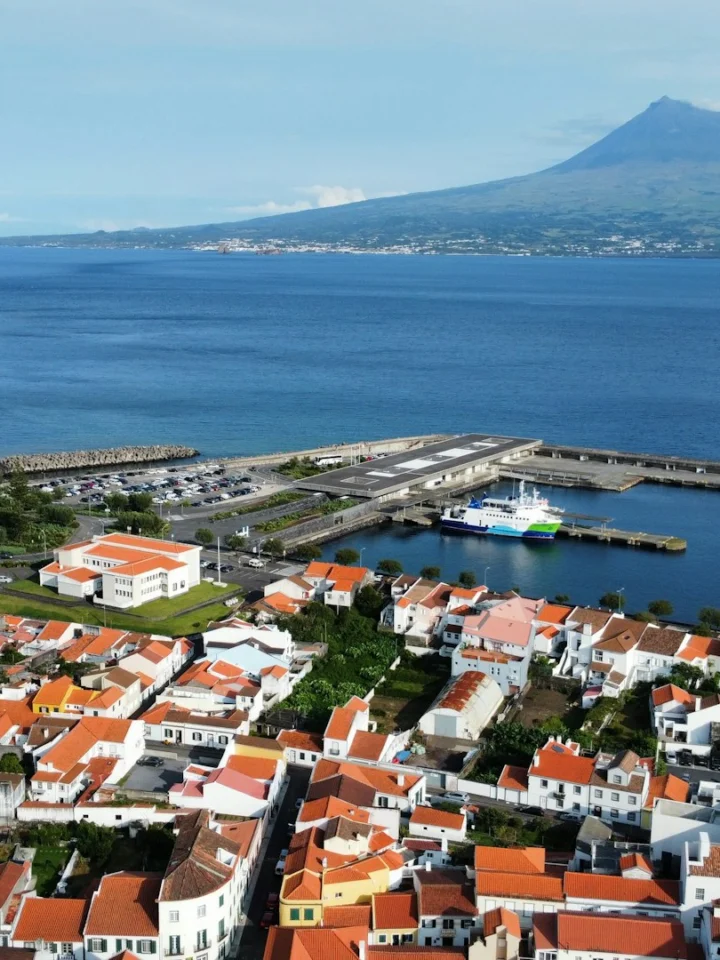
Ponta Delgada, on São Miguel, is the single most common stop on any transatlantic crossing in our data. Ships dock at the city itself, so the old town is a short walk from the gangway. The island is volcanic and green, and the official tourism board’s two big sights are each a short drive from town:
- Sete Cidades, in the west: twin crater lakes, one green and one blue, seen from the Vista do Rei viewpoint.
- Furnas, in the east: a valley of hot springs and fumaroles, where the local stew, cozido, is cooked in the ground. Terra Nostra Park’s thermal pool is the classic stop.
- Lagoa do Fogo, a wilder crater lake between the two.
Full-day tours from the port typically take in Sete Cidades, Lagoa do Fogo and Furnas; a half day covers Sete Cidades or a walk around town. Horta, on Faial, and Praia da Vitória, on Terceira, see far fewer ships. The Azores are one hour behind mainland Portugal and four hours ahead of US Eastern time, and our guide to transatlantic time changes explains how the ship handles those clock changes.
Weather is the catch. The islands sit in open ocean, spring and fall bring Atlantic lows, and the cruise lines reserve the right to change ports for weather or safety. A skipped Azores call turns a two-stop crossing into a week at sea. Our guide to whether transatlantic cruises are rough covers the months when that is most likely.
Bermuda: the stop closest to Florida
Most ships tie up at Kings Wharf in the Royal Naval Dockyard, at the island’s western tip. The Bermuda Tourism Authority describes a ferry of about 20 minutes to Hamilton, and a seasonal ferry to St. George’s in under 40 minutes; the St. George’s route runs roughly May to October, so it may not operate on a spring crossing. Buses also connect the Dockyard with Hamilton, more slowly.
A day is enough for one of three things: Hamilton’s harbor front, the old town of St. George’s, or a south shore beach. The Dockyard itself has museums and shops, and some passengers never leave it. A few smaller luxury ships, such as Regent’s, dock at Hamilton instead.
Bermuda is two days from Florida, so on an eastbound sailing it comes early, before the long run to the Azores, and on a westbound one it is the last port before home.
Madeira and the Canary Islands
Madeira. Funchal is one of the easiest ports in the Atlantic for a day on your own. Visit Madeira says the cruise terminal is about a 10-minute walk from the center. From the waterfront, the Funchal cable car climbs about 560 meters in roughly 15 minutes to Monte, and from Monte you can ride down part of the way in a wicker toboggan steered by two men, about 2 km in 10 minutes. The old town and the market fill the rest of the day.
The Canary Islands. These are Spanish, and westbound ships often call at two of them back to back. The classic stop is Santa Cruz de Tenerife, the base for trips up to Teide National Park, where UNESCO notes the volcano rises to 3,718 meters (12,198 feet), the highest point on Spanish soil. Lanzarote’s volcanic scenery, Gran Canaria’s capital Las Palmas and the small Renaissance town of Santa Cruz de La Palma are the other common calls. From the Canaries the ship turns west, and the run to the Caribbean or Florida is typically six to eight days.
The northern route: Iceland, Greenland and Atlantic Canada
All 13 northern crossings in our data sail between June and September 2027. They swap the long sea runs for a string of ports: Celebrity Silhouette’s 13-night sailing from Cape Liberty to Reykjavik on June 20 calls at Sydney and Halifax in Nova Scotia, St. John’s in Newfoundland, Qaqortoq in Greenland and Isafjordur in Iceland, cruises Prince Christian Sound, and never spends more than two days at sea in a row. Viking runs a similar 14-night route between New York and Reykjavik several times in summer 2027, and Queen Mary 2 has one 14-night version in August 2027.
Expect tenders: Celebrity’s itinerary lists both Qaqortoq and Isafjordur as tender ports. Visit Greenland warns that icebergs can block the mouth of Prince Christian Sound, so the scenic day is never guaranteed. These crossings suit people who want ports more than sea days. The New York end is covered in our guide to repositioning cruises from New York and Boston.
Cape Verde, and crossings with no stop at all
Cape Verde sits far to the south, off West Africa, and only one crossing to North America in our data calls there: Norwegian Viva, Lisbon to Miami on November 1, 2027, which stops at Las Palmas and then Porto Grande, the port of Mindelo, before five days at sea to Tortola. It also appears on Norwegian Star’s Lisbon to Buenos Aires crossing in December 2027, one of the sailings in our guide to South America repositioning cruises.
No stop. Queen Mary 2 makes 21 crossings between New York and Southampton in our data with no port at all, nearly all of them seven nights; the ship was built for the North Atlantic, and the crossing is the point. Mainstream ships sometimes skip the islands too. Royal Caribbean’s Legend of the Seas leaves Fort Lauderdale on April 25, 2027 and spends nine straight days at sea before Cádiz. In our data, about 22 other crossings, mostly Royal Caribbean, Celebrity, Holland America and Norwegian sailings between Florida or Puerto Rico and the Mediterranean, list no mid-ocean stop among their ports.
How to pick a routing
- Two island stops (Bermuda and the Azores, or Madeira and the Canaries) are the easiest first crossing, with no more than four to six sea days together.
- One stop means one run of seven or eight days. Fine if you like sea days, hard if you have never done more than two.
- No stop gives you the purest crossing. On Queen Mary 2 that is seven nights; on a mainstream ship it can be nine days at sea followed by a quick run of Spanish ports.
- The northern route is a port-intensive summer cruise with cooler weather and tenders.
Compare routings on the same dates in the finder, eastbound under crossings to Europe and westbound under crossings from Europe, and open the line’s day-by-day itinerary before booking. If one island is the reason you chose the sailing, remember that a mid-ocean stop has no nearby substitute: when weather closes the port, the day becomes a sea day. Treat it as a bonus rather than the point of the trip.
Questions before booking
Do transatlantic cruises stop anywhere?
Most do. In our data about seven in ten crossings between North America and Europe call at an Atlantic island or at Atlantic Canada, Iceland or Greenland on the way. The exceptions are Queen Mary 2, which sails New York to Southampton in seven nights without a port, and some Florida to Spain crossings that run nine days at sea before reaching Cádiz.
Which transatlantic cruises stop in the Azores?
In our finder, 37 of 151 crossings between North America and Europe call in the Azores, almost all at Ponta Delgada on São Miguel, with a few at Horta on Faial or Praia da Vitória on Terceira. Norwegian and Royal Caribbean have the most, followed by Princess and Celebrity. Most sail eastbound between March and May, and most of the rest westbound in October and November.
How many sea days are on a transatlantic cruise?
Usually 7 to 10 on a 12 to 15 night crossing. On the itineraries we checked, a Bermuda and Azores routing had 9 sea days in 12 nights, an Azores-only routing 10 in 12, and a Fort Lauderdale to Barcelona sailing via Tenerife 10 in 14. Northern routes via Iceland and Greenland have far fewer, about 5 in 13 nights.
What is the transatlantic cruise route?
There are four main lanes. The direct North Atlantic route links New York and Southampton. The central route runs from Florida via Bermuda and the Azores to Portugal, Spain or England. The southern route crosses between the Caribbean and Madeira or the Canary Islands. The northern summer route goes via Newfoundland, Greenland and Iceland.
Do transatlantic cruises stop in Bermuda?
Many do. Bermuda is on 35 of the 151 crossings in our data, usually as the first stop after Florida on eastbound sailings or the last stop before Florida on westbound ones. Most ships dock at the Royal Naval Dockyard, about 20 minutes by ferry from Hamilton. Celebrity has the most Bermuda calls in our data, followed by Regent and Royal Caribbean.
Further voyages
Planning & Costs
Are Repositioning Cruises Worth It? An Honest Answer
Repositioning cruises are worth it if you enjoy sea days, have two weeks to spare and can book the one-way flight early. You get a long voyage for less per night than the same ship's normal cruises, and you arrive on another continent. They are not worth it if you measure a trip in ports, are prone to seasickness, need reliable internet for work, or have fixed dates and an expensive flight home.

Planning & Costs
Transatlantic Cruise With Pets: Taking a Dog or Cat Across the Atlantic by Ship
Only one ship regularly takes pet dogs and cats across the Atlantic: Cunard's Queen Mary 2, which has 24 kennels on Deck 12 and carries pets on selected crossings between New York, Southampton and Hamburg. Pets stay in the kennels for the whole voyage, with set visiting hours and no vet aboard. Royal Caribbean, Norwegian, Celebrity, Princess and Carnival accept trained service dogs only, never pets or emotional support animals.
Planning & Costs
Cheap Repositioning Cruises: How to Find the Lowest Fares
To find cheap repositioning cruises, search by month and route rather than destination: eastbound transatlantic in April, westbound in October and November, Pacific coast runs in April, May and September. Compare MSC, Carnival and Norwegian first, take an inside or guarantee cabin on an older ship, and book the flight home at the same time. As of 2026 the lowest mainstream crossings sell for about $50 to $60 a night including taxes.